Throughout the history of F1 there have been many drivers that have stood out from the rest as those with ‘something special’, those drivers that drag the most out of a car and then some to put in results that some people would describe as defying logic. Names that spring to mind are Senna, Schumacher, Hamilton, Alonso… yet sometimes the brilliance of a driver such as Jim Clark doesn’t get the coverage and conversation that it so readily deserves. Often people state that he was a great driver, and duly so, but never go into details that conversations about Schumacher for example may spark. Jim Clark, over 8 years and 72 races, attained 33 pole positions and 25 race victories but it’s his 2 championships of 1963 and 1965 that we’ll be looking at, to see whether one championship can be seen as a greater achievement.
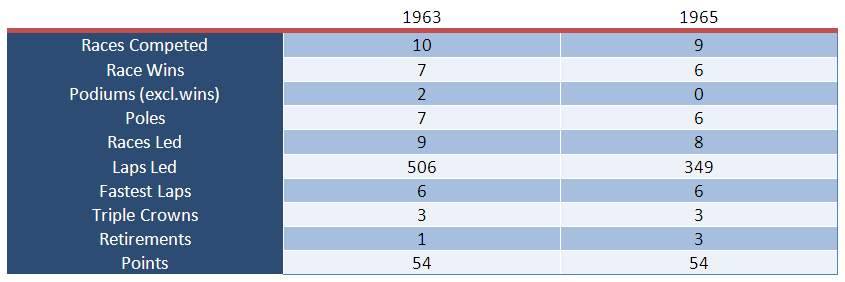

To get a pole position in F1 is obviously a great achievement. It showcases the drivers ability to get the car on the edge and to extract every bit of performance there is and Clark was no exception to that, his 33 poles still enough to claim 5th on the all-time pole sitters list. During his two championship winning years Clark put in some stellar laps which by modern F1 standards would be seen as all conquering. At the French GP during the ’63 campaign Clark achieved pole by 0.7 seconds and then beat the field by 0.9 seconds two races later at the Nurburgring. Round 9 at the Mexican GP saw the largest margin from pole to 2nd that year when Clark went fastest by a remarkable 1.7 seconds. The ’65 season saw this impressive form continue. At the South African GP, Clark began his season with a lap 0.9 seconds faster than anyone else. At the French GP Clark achieved pole by 0.5 seconds but the most remarkable lap from either season was his pole for the German GP which saw Clark beat the field by a staggering 3.4 seconds. For Clark to achieve these kinds of laps in qualifying and to beat his opponents by such margins is a testament to his qualifying speed, especially when he was racing against the likes of Hill, Surtees and Brabham who were impressive in qualifying also. Another fact that must be noted is that Clark was also able to get pole under pressure, when his Lotus-Climax car wasn’t at its regular heights. Two examples of this was his pole at the 1963 South African GP where he got pole by 0.1 seconds. The Mexican GP of 1965 saw a closer margin separate 1st from 2nd, which Clark getting pole by 0.07 seconds. Overall Clark’s average margin of pole during the ’63 season was 0.628 seconds whereas during the ’65 campaign it had increased to 0.878 seconds. Although he gained more pole positions in 1963 it can be concluded that, when he got pole, Clark achieved it by a more impressive margin in 1965 (helped by his 3.4 seconds trouncing of the field in Germany).
Although pole positions are an impressive feat, a driver is most remembered by his race victories and with 33 to his name Clark has a lot to be remembered by. Spa 1963, the 2nd round of the championship, was held in damp and overcast conditions at race start and these conditions allowed Clark to show his brilliance as he pulled away from the field at an impressive rate to the point where by half distance he was 30 seconds ahead of second placed Graham Hill (champion of the season prior). Half way through the race the rain began to fall more heavily and Clark adapted to this wonderfully to cruise to victory by nearly 5 minutes! Clark had lapped all others apart from Bruce McLaren who had just begun his final lap as Clark finished the race. The French GP of that year saw another impressive winning margin by Clark with the field 1 minutes and 49 seconds behind him at the flag. Although the gap isn’t as impressive as his Spa outing the race victory was made more spectacular when the tires he raced on had done 4 GP’s including that race. Furthermore Clark had to nurse an engine problem from lap 12 onwards (the race consisted of 53 laps in total). The victory also saw Clark take back-to-back grand slams (pole, victory, fastest lap, led every lap). During the ’63 campaign 6 of Clark’s 7 victories were lights-to-flag and the only factor stopping it being 7 out of 7 was that Clark didn’t lead for 3 laps at the British GP. The three races Clark didn’t win that year were taken away from him via mechanical problems out of his control and if not for those problems the ’63 campaign could’ve been a clean sweep.
1965 was also a great year for amazing race victories. The French GP at Clermont-Ferrand saw Clark win by 26.3 seconds and although the winning margin might seem tame (calling a 26.3 second win tame goes to show how good Clark was) compared to ’63, Clark did break the lap record 15 times over a 40 lap period. A new lap record every 2.6 laps for 40 laps is something special. His British GP win next time out could serve to be more impressive however. With 20 laps to go Clark’s Lotus started to sound sick… it had run short on oil. For the remaining laps Clark was able to keep the lead thanks to a 34 second gap to Hill behind, losing 3 seconds a lap to him at times. Getting to the end however was an achievement in itself as round corners, Clark shut the engine off to prevent oil surge damage. It was Clark’s 4th straight British GP win. During the 1965 season Clark amassed 6 grand slams, all from his first 6 races and 5 in a row. 5 in a row because Clark missed round 2 at Monaco to compete in the Indy 500… which he and Lotus duly won. For context Hamilton has 5 grand slams in his entire career whereas Clark has the most of any driver with 8. On top of this by the time the title had been wrapped up, Clark had won all races before him. It was a crushing reality for his competitors. 1963 saw Jim Clark finish with a 70% winning record and although he won each race he finished in 1965 it saw him finish win a winning record of 66.6%.
As for the races that Clark didn’t win in each season… Monaco ’63 he was leading from Hill until a jammed gearbox on lap 79 put pay to a well worked 17 seconds gap from lap 17 and a the chance to win the Monaco GP, what would’ve been Clark’s first victory around the streets. In Germany 1963, an engine glitch halted Clark’s chances of hunting down Surtees for the win but did well to finish considering the problem had plagued him for most of the race and the fact his last lap took around a minute longer than it would otherwise. Clark finished 2nd. At the Mexican GP the same year Clark’s race was curtailed from the start as a dud battery saw him start the race but only as everyone else had completed their first lap. Despite this Clark still managed a 3rd place from the race. During the ’65 season at Italy, Clark was looking at a 3rd place but a fuel pump failure on lap 63 meant he had to retire. The next race at Watkins Glen he suffered engine problems whilst a 2nd place looked like it was on the cards as Hill had held off his attack and had managed to pull away. Clark suffered another engine problem at Mexico making it three D.N.F’s in a row and another possible 2nd place taken away from him. The net amount of points lost due to reliability in 1963 was 19 points, whereas it was 16 points for the ’65 season. In terms of points attained, both seasons saw Clark finish on 54 points. However, due to missing Monaco for the Indy 500 and with having 2 more D.N.F’s during the season than 1963 and still amassing 54 points, indicates that 1965 was a more efficient and profitable point scoring year for Clark. The average points per race finished in 1963 was 6 whereas in 1965 it was 9 (not including Monaco as he wasn’t actually there to compete).
Overall, given the facts present, the 1965 season was the better year for Jim Clark. Not only had he improved upon his qualifying performance, he was more efficient when it came to picking up points in the races he could finish within his control (no D.N.F’s) with the average points per race being higher in 1965 than in 1963. Although his winning record percentage was lower in 1965 than in 1963, the deficit could’ve been made up with one more race win notably at Monaco where he wasn’t actually there to compete and at which he won at another venue. The final reason as to why 1965 was the better year for Clark was his 6 grand slams in one season and 5 in a row. To get a single grand slam is a great achievement but to get 6 in one season is mind blowing given how hard they are to achieve. None of this should detract however from the driving genius that was Jim Clark. Had he not sadly died in that F2 race at Hockenheim in 1968, and had been dealt better luck, another championship would’ve surely fallen his way. Out of his 2 though, 1965 serves to present Jim Clark in the clearest light.
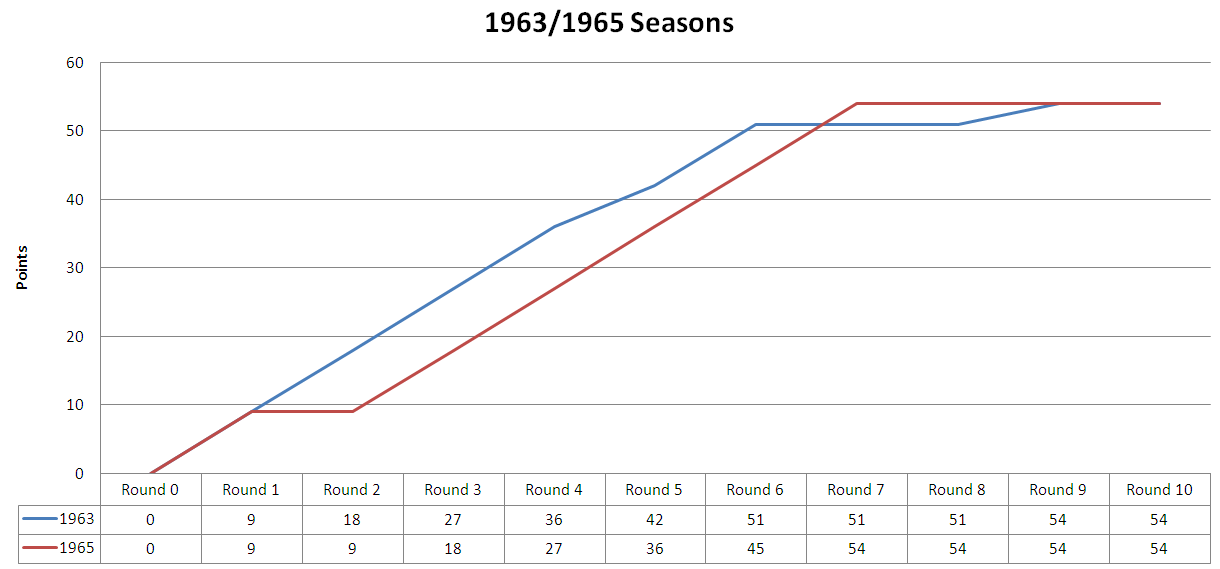
*All result table and graphs are my own work