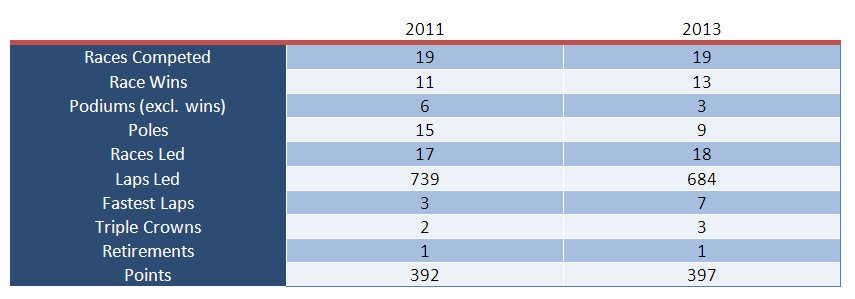
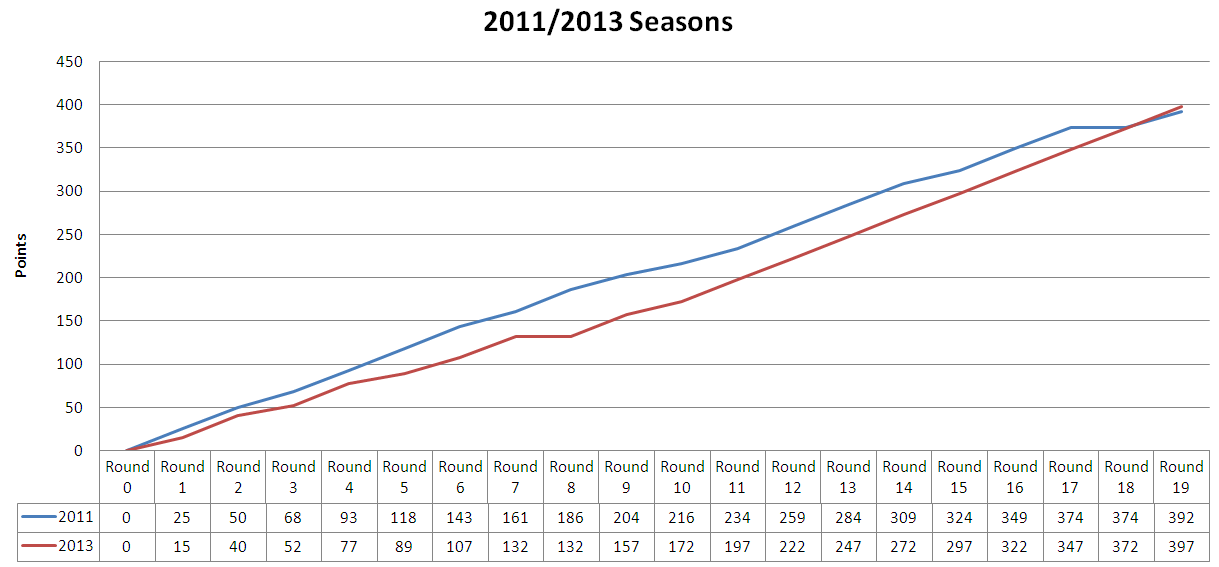
For the last 10 years now Sebastian Vettel has been close to atop, or atop instead, the proverbial Formula One mountain and with a 2018 season on the rise again its safe to say that he’ll be for several more years. The most successful period of his career was spent at Red Bull where he won his 4 straight world titles between 2010 and 2013 and its the titles of 2011 and 2013 that showcase what Vettel can do when he has the car in the sweet spot and its these titles that will be compared. Both seasons featured devastating pace in qualifying and the race from Sebastian, pace that couldn’t consistently be matched or challenged by team-mate Webber. 3 notable race wins and pole positions from each season will be talked about along with potential wins or potential losses and a tables for other relevant statistics.

Standout Races from 2011 + 2013:
There were multiple standout races for Vettel in 2011. In Australia he controlled the race from the front to win by 22 seconds without running KERS unlike the rest of the grid did minus team-mate Webber. It showed his ability to control a race perfectly and how his knowledge of the new Pirelli tires and how to manage them surpassed that of all other drivers and to no surprise as pre-season Vettel was the only driver to visit the Pirelli headquarters to learn about the tires that Pirelli were making. Spain was a race that showed Vettel’s composure. After being overtaken by Alonso at the start due to a memorable start from the Spaniard Vettel retook the lead off Alonso during the pit-stops. From there Vettel was shadowed by Hamilton, the McLaren never more than 2 seconds behind during the final laps. In the end Vettel fended off the challenge and kept his composure to win by 0.6 seconds. Later that year in India Vettel had another standout drive. The Indian Grand Prix was new to the calendar and Vettel adapted to the track best going on to get pole, take victory, getting fastest lap and leading every lap to achieve his first career grand-slam. The closest challenge came from that of Button in the McLaren but he finished 8 seconds off.
2013 wasn’t short of great race performances from Vettel either. Canada was routine (if there every is such a thing as routine in Formula One). By the end of lap 1 Vettel was 2 seconds ahead and out of the DRS detection zone, by lap 30 he was 18 seconds ahead and the end result saw him take the win by 14 seconds. Singapore was a representation of the pure pace of Vettel and his RB9. A safety car came out before Vettel’s pit window and so after the safety car had come in he needed to gain 30 seconds over Alonso (4th and the first in the line of cars to have pitted twice) to pit and resume in the lead… it took Vettel just 13 laps. He ended up winning by 32.6 seconds and it was the race when people started to ask ‘when’ not ‘if’ he would get his 4th title. In India Vettel showed great tire management, great pace and adept skill in making his way through the field. He needed to make his way through the field as he got rid of his quickly degrading option tires for primes on at the end of lap 2. Vettel would win by 29 seconds and he would claim his 4th title in the process. On the whole the race represented the season with great strategy from Red Bull and blinding pace from Vettel, famously being told not to go for fastest lap by his race engineer.
There are examples from both years of victories that could’ve been and shouldn’t have been. Canada 2011 would’ve been 6 out of 7 but on the last lap Vettel dipped a tyre off the dry line and half-spun, doing well to hold it, after pressure from Button who was closing in. Vettel ended up in 2nd. The final two races of the year also were hampered by problems. In Abu Dhabi Vettel started from pole but picked up a mysterious right rear puncture that is yet to be fully explained at turn 2 on lap 1 that resulted in suspension damage (some people say it was hot exhaust gases directed to the rear diffuser that passed by the rear tyre that weakened the tyres structure, others say his run over the curb on the exit of turn 1 could’ve caused the puncture) and Vettel’s first retirement of the year and the first since Korea 2010. In Brazil Vettel was leading but hit a gearbox problem which allowed Webber to take the win. Vettel brilliantly brought the car home for 2nd however. In 2013 a win that got away was the British Grand Prix. After several tyre failures Vettel found himself in the lead but a gearbox failure forced him to retire. Given that Red Bull’s tyre wear was better than that of the Mercedes (Red Bulls closest challenge that weekend) it is to expected that Vettel would’ve won. Earlier that year there was a race that should’ve gone the way of Webber not Vettel. The imfamous ‘Multi 21’. Had Vettel obeyed team orders he would’ve finished 2nd.
Standout Qualifying Runs from 2011 + 2013:
2011 was a record breaking year in terms of qualifying with Vettel surpassing Mansell’s record of 14 pole positions in a single year with 15. In Australia Vettel achieved pole by 0.778 seconds even though he wasn’t running KERS. It was an ominous statement of intent from the new champion. In Turkey he got pole by 0.405 seconds but what makes it special is that he only did one run in Q3 whilst everyone else did 2 and they still couldn’t beat it. The last round in Brazil was special for the aforementioned record of 15 poles in a single year which still stands to this day. At the Malaysian Grand Prix in 2013 Q3 was in wet, tricky and changeable conditions but Vettel made an inspired decision to fit on a new set of intermediates and managed to get his 38th pole by 0.913 seconds. In Korea Vettel got pole by 0.218 by doing just one run once again such was his confidence in his machinery. In India he got pole by the impressive margin of 0.752 but was made more impressive because that was the race he could win the championship and thus to pull out a lap such as that with the added pressure is why its more so impressive. It would also be his third pole in three years at the Buddh International Circuit, a track that Vettel made his own.
Overall:
Both seasons from a performance point of view were marvels with levels of driver, car and team confidence rarely seen. 2011 was the more consistent and overall more dominant season as Red Bull weren’t as closely and consistently challenged as in 2013 (especially in qualifying as Red Bull managed 18 out of 19 poles positions) but 2013 was the season for pure driving confidence. The most wins in a row Vettel achieved in 2011 was 3 (on two occasions) whereas in 2013 Vettel won 9 out of the last 9 races and all post-summer break to set a new record for successive race wins and to equal Schumacher’s record for 13 wins in a year. An example of this confidence in the 2013 Red Bull was in Abu Dhabi where Vettel was at points a whole second a lap faster than his closest challengers. Vettel had quoted the pace from that race as ‘scary’. 2011 was the more consistent season but when Vettel found his grove in 2013 he would become unbeatable.
Fun Facts:
-Vettel’s point tally in 2011 (392) beat that of Ferrari as a whole (375 and 3rd in the constructors).
-Vettel’s point tally from 2013 (397) beat that Mercedes as a whole (360 and 2nd in the constructors).
-If there were 6 more races in the 2013 season and Alonso were to win them all with Vettel DNF’ing in all, Alonso would still finish 5 points behind Vettel (397 to 242- 6 wins would be 150 points)
*All results tables and graphs are my own work