Ferrari are the most historic and successful team in Formula One history having been competing since the beginning in 1950 and amassing 15 drivers titles and 16 constructors titles. The image of the ‘Prancing Horse’ and the scarlet red cars is one of the most historic in any sport let alone F1. But despite this I believe the modern image of Ferrari in F1, concerning the ability to win rather than the brand image alone, is heavily reliant on Schumacher and his 11 year stint at the team which ended with 6 constructors championships and 5 drivers championships in a row rather than all the other years of its history. On top of this I believe that McLaren and Williams (F1’s other historic teams) could hold a candle to Ferrari on a more regular and legitimate basis had the Scuderia been without Schumacher and subsequently the majority of the success of the 2000’s as well as the extra years they were able to compete in from the 50’s and 60’s. This piece aims to analyse these statements and to show that once a wider look of F1’s history is had, Ferrari aren’t the all successful giant they are so hastily seen and believed to be.
Ferrari’s Reliance on Schumacher:
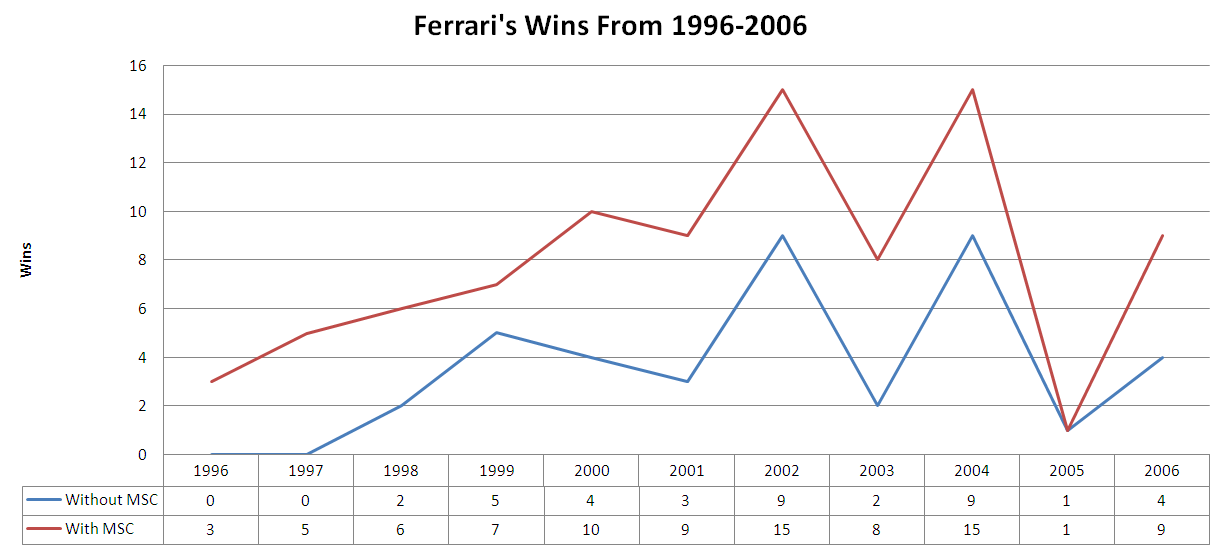
Ferrari’s win count at the conclusion of the 2017 season was 215 wins, the most of any team by 33. If we remove Schumacher from the equation however Ferrari’s win count drops to 168 wins. This does factor in 1-2 finishes for Ferrari. For example if Schumacher led home a 1-2 finish ahead of Barrichello, it would be Barrichello’s win and Ferrari would still get that win. Even with this though it’s a significant drop of 47 wins. A more extreme scenario would be to eliminate the years Schumacher was at Ferrari, 1996-2006, from Ferrari’s win count. Doing so would result in Ferrari having 127 wins, a further loss of 41. Just from these scenarios it presents the late 90’s and early/mid 2000’s as an important period for Ferrari in establishing the image of themselves having the ability to win season on season especially given the fact that between 1979 and 1996 (1979 being the last year a driver won the drivers championship for Ferrari until Schumacher), Ferrari weren’t really the serial winners we know them as today. In those 16 years they managed only 2 constructors championship wins, those being 1982 and 1983, winning those by 5 points and 10 points respectively. On top of that they only had 4 legitimate title challenges (1982, 1983, 1985 and 1990). If Ferrari had that record nowadays then surely the seat their would not be as attractive. I doubt Vettel or Alonso would’ve made a move to the Scuderia if this was so.
Furthermore, Schumacher not only brought a tremendous amount of success to Ferrari via driving but he also helped build a great team. Bringing Ross Brawn and Rory Byrne from Benetton was the final pieces needed to make Ferrari into the well-oiled machine we know they were, particularly from 2000-2004. It didn’t just benefit Schumacher though as the car Raikkonen raced in 2007 was the brain-child of the Brawn-Byrne era as they built it to near completion before they left at the end of 2006. Without Brawn’s and Byrne’s input on the 2007 car I doubt Raikkonen would’ve won that years title, especially when McLaren’s car was the fastest that year anyway. Not only would the car not be as well designed but the team as a whole, without Schumacher, would not be going into the 2007 season having won 5 out the last 7 drivers titles and 6 out of the last 8 constructors titles. The team momentum wouldn’t have been there, making a title win that year seem even less likely.
Comparison To McLaren:
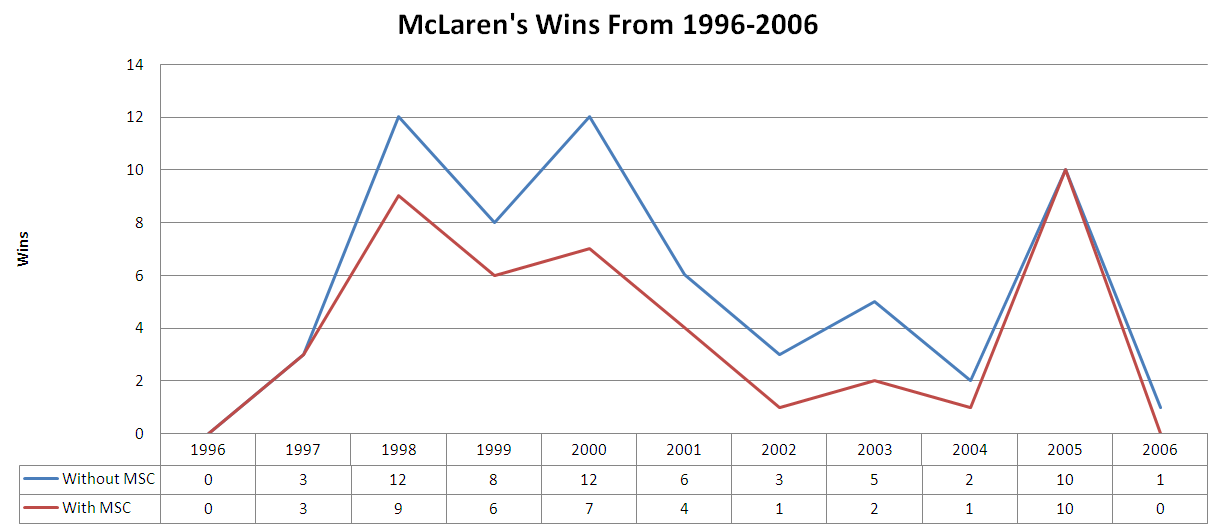
McLaren are, historically, Ferrari’s closest challenges with the two teams fighting for the championship on 11 occasions, ’72, ’75, ’76, ’85, ’90, ’98, ’99, ’00, ’03, ’07 and ’08 (these are when the two teams are each others closest challengers and that there was actual competition which eliminates the likes of 2001 as Schumacher won the title by 58 points over Coulthard). It is therefore of interest to see how McLaren’s fortunes would turn out if Schumacher hadn’t raced for the Scuderia. From their beginning in 1966 McLaren have won 182 races which is the second highest of any team. If we remove Schumacher from the years 1996-2006, like we did with Ferrari, McLaren would end up with a total of 200 wins. Its an increase of 18 and given that Ferrari’s win total would be 168 in the same scenario it helps, once again, to put the importance of the 90’s and 00’s into perspective for Ferrari. Take away the entirety of the period 1996-2006 then McLarens win total would be 139, 12 more than Ferrari in the same scenario. With Schumacher absent from Ferrari it would also open the door for McLaren to take some titles they didn’t do otherwise. Titles such as 2000 and 2001 would have surely been won by Haikkinen and Coulthard respectively. Raikkonen would likely have picked up a championship in 2003 and without Ferrari being such a close competitor in 2007 either Hamilton or Alonso would’ve won that years title. With the added monetary benefits from winning championships who knows what success McLaren could’ve had on top of what they have had since 2008.
Comparison To Williams:
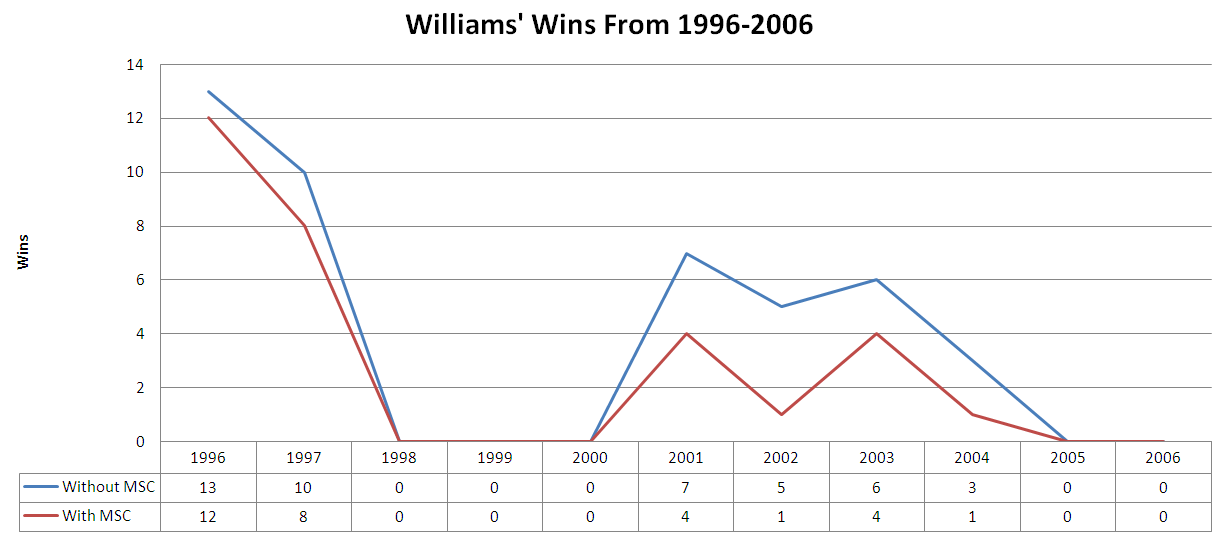
The rivalry between Williams and Ferrari is one of the most iconic in Formula One history,only being beaten by that of the McLaren-Ferrari rivalry. The two teams have fought for the title on multiple occasions with the battle in 1997 between Villeneuve and Schumacher being the most iconic. Being the youngest of the three teams in this comparison Williams naturally have the least amount of wins with 114, but any team that has over 100 wins in a sport as brutal and as subject to change as F1 is a major achievement and should not be looked down upon. Once again if we apply the first scenario to Williams (minus Schumacher from 1996-2006) the teams win count becomes 129, an increase of 15. If we eliminate the years 1996-2006 then Williams drop to 84 wins. Likewise with McLaren, the absence of Schumacher would open up title opportunities that Williams could’ve taken. The 1997 title fight would’ve been an easier affair meaning that Williams could’ve diverted more time and resources on their 1998 car, possibly allowing another title run in 1998 that could well have run over into 1999, 2000 and so on. The close title fight in 2003 saw Schumacher face off against Raikkonen and Montoya and with Schumacher out of the equation the 2003 title could have as easily fell into the hands of Williams rather than McLaren. Concerning the constructors standings for that year it’ll be imagined that the Williams duo would’ve done the job as they beat McLaren in the original standings.
Scenarios and Win Statistics:
For the sake of comparison I thought it would be a good idea to compare all three teams given different scenarios outside of the main argument of the piece whilst also serving to enhance the main argument. This includes starting all three teams from 1977 as that’s when Williams began to race, helping to see how much success each team would get given the same amount of time and so on. Also there are the scenarios mentioned above but in a more convenient form for quick viewing.
As of 2017:
- Ferrari= 215 wins
- McLaren= 182 wins
- Williams= 114 wins
Minus ’96-’06:
- McLaren= 139 wins
- Ferrari= 127 wins
- Williams= 84 wins
Minus Schumacher from ’96-’06:
- McLaren= 200 wins
- Ferrari= 168 wins
- Williams= 129 wins
Minus ’50-’76:
- McLaren= 161 wins
- Ferrari= 151 wins
- Williams= 114 wins
Minus ’50-’76 + ’96-’06:
- McLaren= 118 wins
- Williams= 84 wins
- Ferrari= 63 wins
Minus ’50-’76 + Schumacher from ’96-’06:
- McLaren =179 wins
- Williams= 129 wins
- Ferrari= 104 wins
Conclusions:
Ferrari are a great team, steeped in history, and Formula One, for the most part, are better off with them competing and challenging for race victories. As shown though, I believe this almost mystical image of Ferrari’s success in F1 and their ability to win every season is heavily reliant on Schumacher and his run of championships. In the absence of Schumacher and the ’96-’06 period every scenario points towards McLaren being more successful and by some margin, but McLaren aren’t seen in this mystical light as Ferrari are, making me believe that its this period of the late 90’s to mid 00’s that has really elevated Ferrari. It’s also interesting to see that if all three teams started in 1977 and Ferrari had never signed Schumacher then Ferrari would be the least successful out of them. Ferrari always have the potential to win but it seems to take an extremely motivated, calm and determined driver to extract that potential. For example, Lauda took the team by the scruff of the neck and made them into a championship winners. In 1973 the team finished 6th on 12 points. In 1974 they were 2nd with 65. Lauda would then take two titles in 1975 and 1977, missing out of the 1976 title by one point. The development of the car whilst Lauda was at the team gave a strong base for Scheckter to take the title in 1979 Schumacher did a similar feat as he brought Benetton members to the team and that allowed the maximum potential of the Scuderia to be unleashed after multiple years in the relative wilderness.
This transformation of Ferrari didn’t happen under Alonso, neither is it happening under Vettel, and both are empty handed from their stints at Maranello (Vettel still has a few years but he should’ve won the 2018 title and arguably the 2017 title). Since 2009 the team haven’t made championship winning cars, the only ones worthy of titles would be the 2010 car, the 2017 car and the 2018 car. Without Schumacher this run could’ve extended through the 2000’s and into the 90’s and thus it becomes clear how Ferrari, behind the Schumacher mask, aren’t really as successful as they appear to be on the surface.
*All results tables and graphs are my own work