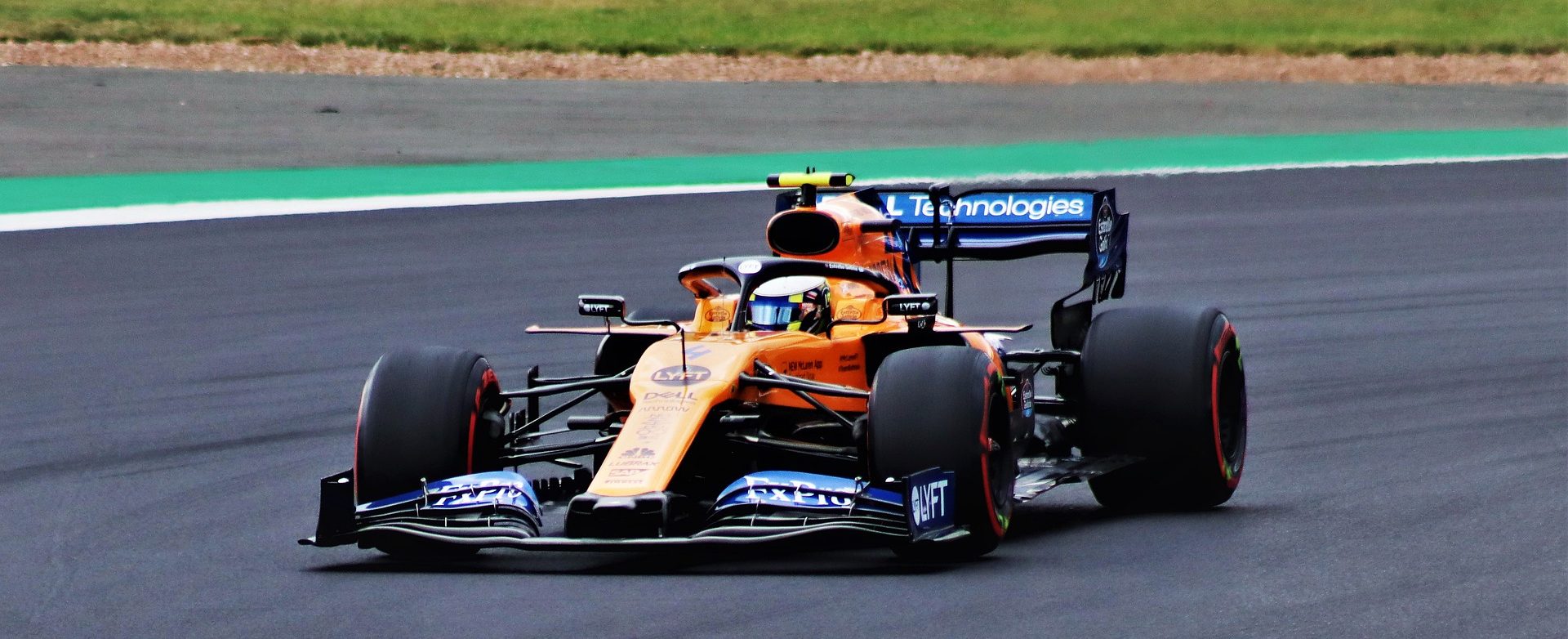
Haikkinen’s title triumph in 1998 surely has to be one of the most remarkable in F1 history. This is because at the last race of the 1995 season, in Adelaide, Haikkinen suffered a life threatening injury after a crash caused by a rear tyre failure at the end of a long straight, throwing the car into the tyre barrier. He was taken to hospital in a coma. Three years later he was champion. He would do the double in 1999 to become only the seventh driver to win back to back titles. From a car performance perspective the 1998 season was the more dominant as McLaren has jumped ahead of everyone in adapting to the new ‘narrow car’ designs, whereas 1999 was the more theatrical season with Ferrari being closer and Jordan even challenging with H-H Frentzen. Nevertheless both seasons showcased the speed and talent that Haikkinen possessed and this piece is going to give some of the best examples of that speed and talent in races situations and in qualifying runs.
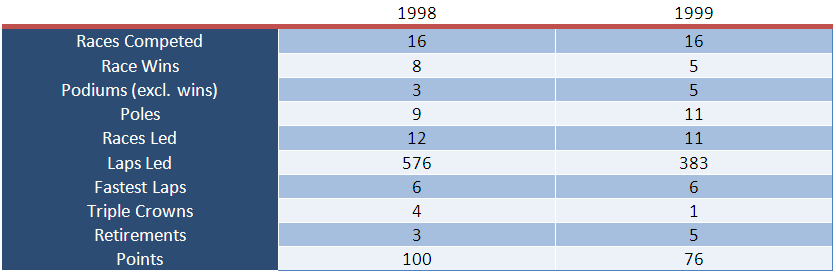

Standout Races from 1998-1999:
With the McLaren being the best car in the field in 1998 there were bound to be races where driver and car came together to create the ultimate package and that was the case at Monaco that year. By Haikkinen’s own admittance it was his best ever race win. It was a faultless performance at the toughest track to ace. Haikkinen managed to get pole, win the race, lead every lap and set the fastest lap. A Monaco grand slam made it 4 wins from the first 6 races, both Schumacher and Coulthard only on one apiece. Later that year at the Nurburgring Haikkinen won a decisive race on merit where driver and team tactics ruled. A great pass on Irvine allowed Haikkinen to close up on Schumacher before the first stops. Once Schumacher pitted Haikkinen, on a long first stint, set qualifying laps to pit and rejoin in the lead, a lead that he would not lose. It gave Haikkinen a 4 point lead going into the finale in Japan. Earlier that year at Silverstone, although not a victory, it was a great performance for the most part by Haikkinen in a race that must’ve felt robbed from him. The first part of the race was a great display of skill in dire, wet conditions as within a 50 lap period Haikkinen had pulled out a 40 second lead over Schumacher. A spin meant Haikkinen had picked up a bit of front wing damage but he had the gap to come into a pit and still retain the lead. That was until the safety car was brought out due to the worsening weather, destroying Haikkinen’s lead. To top it off, Schumacher and Ferrari also won in a sketchy, if at the time legal, fashion with Schumacher serving a stop-and-go penalty on the last lap. By crossing the finishing line in the pits he had technically won the race before serving the stop-and-go, essentially getting away without serving it. It was deemed legal as he entered the pits before crossing the finish line to end the race.
1999 was another great year for Haikkinen. In Austria it was a McLaren 1-2 with Haikkinen on pole but the 1-2 didn’t last long. Coulthard tagging Haikkinen at turn 3 spun the Finnish driver and left him at the back of the grid. What followed was great passing and a great recovery drive up to the podium in P3. In Hungary the situation played out as planned, a McLaren 1-3 in qualifying finished with a McLaren 1-2 in the race. Haikkinen lead every lap to win in textbook fashion. What made it more special was that Haikkinen hadn’t won a race in 4, picking up just 10 points in that time, and thus it was important to keep himself in the title fight. The situation going into the final race at Susuka was that Haikkinen was 4 points behind the Ferrari of Irvine and realistically needed a win to claim his second title. Despite the mounting pressure, Haikkinen jumped Schumacher at the start and he and McLaren didn’t miss a beat, leading Haikkinen to his 2nd title. The Ferrari of Schumacher was never far behind, 5 seconds at the flag, but never seemed to be a match.
Standout Qualifying Runs from 1998-1999:
Over the two years qualifying has to be seen as one of Haikkinen’s strongest and most important attributes especially when the hard, grooved tyres made overtaking difficult and promoted more driver mistakes. At round 2 in Brazil, 1998, Haikkinen managed to get pole by 0.665 over team-mate Coulthard, a great margin given that they both had the same car. On top of this McLaren had their ‘brake-steer’ system banned and still managed to get a 1-2 on the grid. The ‘brake-steer’ system allowed the rear brakes to be used independently from one another. For example if you were going through a right-hand turn there would be a switch that allowed the driver to use just one rear brake (for right hand turns it would be the rear right). This allowed the car to rotate more and thus a greater cornering speed could be achieved. Three races later at Spain Haikkinen beat his team-mate by 0.734 seconds. Just mighty, but not surprising, as Haikkinen would win three races in a row in Spain between 1998-2000. A race later at Monaco, the hardest track to get right, Haikkinen got pole by 0.339 seconds. Given that Monaco is the shortest track on the calendar it’s quite rare that a gap that big is achieved as there is ‘less track’ to find time.
1999 was probably a more dominant year in terms of qualifying for Haikkinen. The first round in Australia had questions surrounding whether McLaren still had the fastest car. Haikkinen answered some doubters by getting pole by 0.484 secs. The gap between first and second in qualifying has only been greater on 4 occasions in 19 years (2005, 2011, 2015 and 2018) making it an even bigger achievement. Round 4 at Monaco, the battle for pole was between Haikkinen and Schumacher. Haikkinen had it only for Schumacher to snatch it back. On Haikkinen’s last run, when the pressure was at its highest, he managed to get pole by 0.064 seconds. Later that year at Silverstone Haikkinen got pole by 0.494 seconds and was his sixth pole in eight races. Overall Haikkinen’s 1999 pole tally ranks as joint 4th on the all-time list behind the likes Vettel in 2011 with 15 poles and Senna in 1988 with 13 poles and equal with the likes of Schumacher in 2001 and Rosberg in 2014.
Overall:
Both years saw Haikkinen at his best and the true potential of a well oiled and drilled McLaren team. The 1999 season was the more successful in terms of qualifying but the 1998 season was the better overall season. This can be put down to a better car advantage and also due to some great drives like the victory in Monaco and those three wins in the final three races to seal the title after a Schumacher mid-season resurgence. In comparison the 1999 had shades of the opposite. The six races of which Schumacher didn’t contest, due to a broken leg, Haikkinen only won once. Of course there were some mechanical issues preventing a more successful run but if the same scenario would’ve panned out in 1998, I doubt McLaren would have had that amount of problems and thus a more successful run. On the other side of the proverbial 1999 coin there were some great drives from Haikkinen as are documented above and a lack of luck should be pointed out as for a less successful season rather than a lack of motivation or skill.
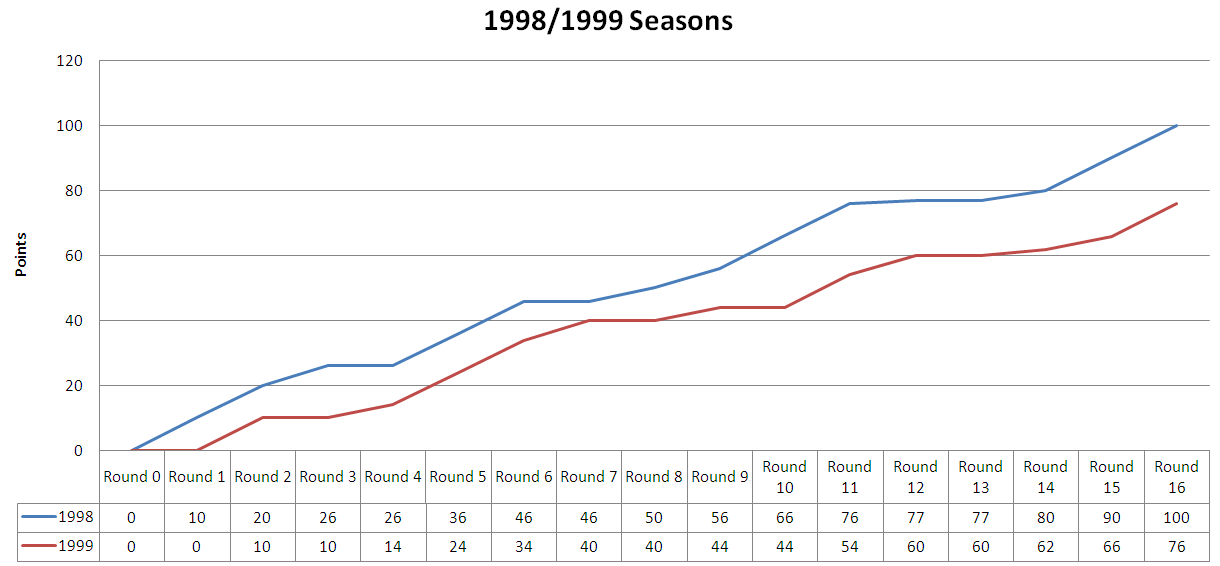
*All results tables and graphs are my own work