For the majority of grand prix history safety was never seen or able to be realised as the number one issue and an area needing much improvement. This can be attributed to two reasons: the attitudes of given times and the available technology. The attitudes given times especially during the 50’s was that motor racing wasn’t particularly dangerous and if someone was hurt then that is what comes with racing, after all in the 50’s it was the first time a major international event had occurred without it being a war and having people be shot at so motor racing by comparison was wonderfully safe. The available technology from years past wasn’t advanced enough to make racing safer either especially when you compare it to technology today. Prior to 1981 people couldn’t make a chassis from carbon fibre and thus had to stick with the heavier and not so safe norm of aluminium. Also concerning head injuries, not a lot was understood about head trauma let alone how to treat it.
With all that in mind it’s not really surprising that the introduction of safety measures was slow and sometimes ineffective. Safety only really became a major, major concern after the tragic passing of Ayrton Senna at the 1994 San Marino Grand Prix. Since then there have been multiple rule changes and safety measures introduced to F1 to make the sport a lot safer. This piece aims to look at the most notable of these developments and to showcase the changing attitudes towards driver and track safety.
Improvements In Car Safety
Roll Hoop:
The roll hoop was introduced in 1961 to protect the driver’s head in the event of the car rolling over. The initial model, by modern standards, seems like a low effort ‘just slap it on’ kind of job and given its effectiveness it seemed like just that. At the 1961 Italian Grand Prix Von Tripps’ Ferrari got on the grass and made contact with the tyre of Jim Clark’s Lotus whilst fighting for 4th, this resulted in the Ferrari catapulting and launching Von Tripps from the car onto the grass whilst the car landed in the crowd. The accident claimed the lives of Von Tripps and 14 spectators. Clearly in this scenario the roll hoop didn’t help in any way and this is why it can be seen as a safety measure that had little impact on driver safety back then. Nowadays it has become an instrumental part of the cars design and had saved many drivers from injury or worse. A great example of this is Mark Webber’s crash at the 2010 European Grand Prix, when he hit the rear of Kovalainen’s Lotus. The front of the Red Bull was sent upwards and the car ended up initially landing upside down. The roll hoop absorbed the energy from the crash and Webber walked away as if nothing had happened.
Rear Lights:
With the introduction of rear flashing lights on F1 cars (1971) it helped judge where the car ahead was in low visibility conditions and in modern F1 it tells the driver behind whether the car ahead is harvesting energy and thus will be slower. Of course it doesn’t work in all cases, for example Vettel running into the back of Webber behind the safety car in Fuji 2007, but without it there would surely have been many more cases of cars running into the back of each other in low visibility conditions.
Safety Cell:
There are multiple parts that make up the safety cell and there is no one point when the safety cell came into being. The first development could have been the introduction of the carbon fibre cockpit/chassis as a crash at Monza in 1981 with John Watson showed the protective properties of carbon fibre. The McLaren spun on the exit of the second Lesmo and hit the inside barrier then spun across the track and came to rest on the grass exit. The car had essentially been torn in half but Watson was unhurt and he later said that if his chassis had been made from aluminium then he wouldn’t have survived. In 1988 further measures were taken concerning the drivers feet. A safer and better tested pedal box was made mandatory as to prevent cases of a drivers feet/legs being badly damaged like Pironi in 1982 who suffered career ending injuries to his legs.
After the loss of Ayrton Senna in 1994 the F.I.A mandated the introduction of higher cockpit sides for the 1996 season to prevent the likelihood of lateral hits to the drivers head. This rule is most prominent on the Ferrari of that year. Also the headrest had to be made from an energy absorbing foam. Energy absorbing foam was also heavily used in the side pods of the car and along with crumple zones (pieces of the car that are purposely made to shatter on impact to dissipate energy) made the cockpit one of the safest places to be in the event of a crash. To see examples of how safe the cell of an F1 car has become one only need look at the crashes of Trulli at Silverstone (2004), Kubica at Circuit Gilles Villeneuve (2007), Webber in Valencia (2010), Alonso at Albert Park (2016) and Ericsson at Monza (2018). All these crashes were huge and would’ve taken lives 30 years ago but now the worst injury from these was a cracked rib and minor concussion.
Wheel Tethers:
Introduced in 1998, wheel tethers are zylon tethers within the suspension arms that connect at points on the chassis and the hub of the wheel. Since 2011 each wheel has been required to have two tethers attached to it. The aim of the tethers is to prevent the wheels detaching from the car in the event of a crash as errant wheels can be just as dangerous to fans and marshals as the crash itself to the driver, if not more so. Two tethers were eventually mandated as there were incidents that occurred when only one was used on each wheel. Paolo Gislimberti and Graham Beveridge both lost their lives at the 2000 Italian Grand Prix and the 2001 Canadian Grand Prix respectively due to errant wheels hitting them.
The spectacular suspension failure of Buemi’s Toro Rosso during Free Practice at the 2010 Chinese Grand Prix is an example of when wheel tethers won’t help either way. Both front wheels sheared off the car and were free at around 100mph until they came to a rest at the end of a thankfully long run-off area. But despite this wheel tethers are a massive positive for car safety and have undoubtedly prevented many from serious and potentially fatal injuries.
The Halo:
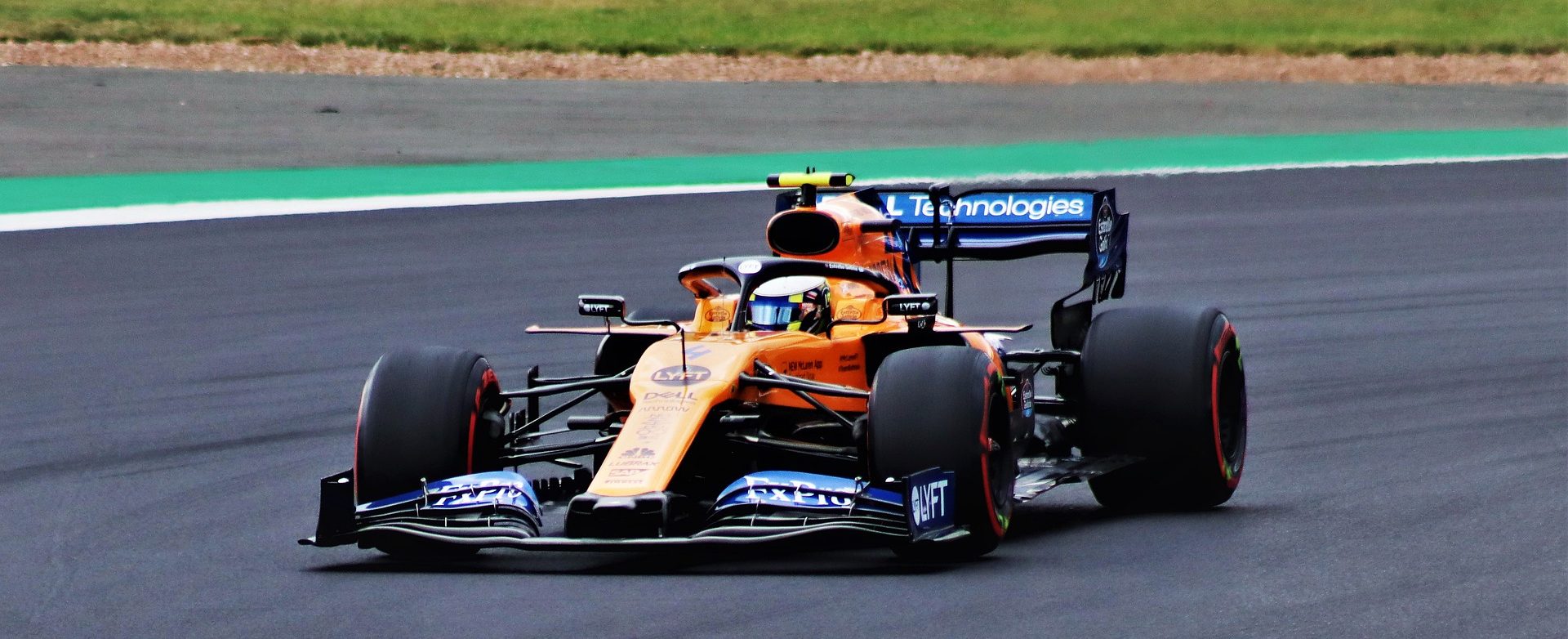
The first time viewing the device was a concept by Mercedes in 2015 yet the first time it was seen in real life was on the Ferrari of Vettel at the 2016 pre-season tests.After multiple tests throughout 2016 and early 2017 the design was made mandatory for the 2018 season onwards. To say that the halo faced criticism would be a gross understatement with fans and drivers either rejecting the need for further cockpit protection, feeling it was a knee-jerk reaction to the Bianchi crash in 2014, or pushing for some form of protection that would look more aesthetically pleasing, as people thought the halo looked like a flip-flop.
In its first year however the halo had proven itself twice. The first time was in an F2 race at Barcelona when one car reared up over another car and ended up with a tyre on the halo. Without the halo the tyre or the bottom of the car would’ve hit the driver on the head. The second time was when Alonso’s McLaren was rammed by Hulkenburg’s Renault which sent it up and over the Sauber of Leclerc. The halo prevented the edge of Alonso’s tyre and wing end-plate from hitting Leclerc in the head, preventing possible head injury.
The halo itself is made from titanium and weights around 9kg and is the same for each team although each team can add small aero winglets to the top of the structure. The halo can withstand the weight of a London double-decker bus sat on top of it and tens of kilo-newtons of force from all directions. Despite its appearance the halo has blended into the design of the F1 car and many people hardly notice it anymore which is only a positive.
Improvements To Track Safety
Armco Barriers:
More armco barriers were placed around circuits in 1971 as prior to that there weren’t enough at key points of the track and the ones that were there sometimes didn’t work. An example of this was Jochen Rindt’s fatal crash at Monza in 1970. Breaking for Parabolica Rindt’s Lotus 72C inexplicably veered of to the left and the armco barrier that he hit buckled under the force of the impact leading to the front of the Lotus sliding under the barrier. Rindt, only using 4 of the 5 seat belts available slid down in the cockpit and suffered fatal throat injuries. Despite Rindt not helping himself he wouldn’t have slid so far down in the cockpit had the barrier remained intact. Since then armco barriers haven’t only been more plentiful but also taller to give ‘more wall’ to hit and to dissipate energy. The shape of the barriers themselves help to absorb as much energy as possible as they allowed for contortion and slight bending. After a big hit they do need repairing/ replacing however (Raikkonen at Silverstone 2014 is a good example).
Catch Fencing:
Introduced in 1974, catch fencing is one safety development that seemed to make the crash more dangerous. Catch fencing was essentially fence posts with a wire mesh between them, which in the event of a crash would wrap around the car to slow it down before it hit the barrier. The problem with this however is that on impact the car being entangled in the mesh can be dangerous for the driver as it could trap them in a potentially fire-ridden car. On top of that a fence post could potentially swing round and hit the driver on the head. Thankfully the idea was discontinued from the 1985 season onwards.
‘TECPRO’ Barriers
TECPRO barriers are now on almost every corner of every track on the F1 calendar, characterised by their rounded chevron shape being either white, grey or red. The positives of TECPRO barriers is that it helps absorb energy from the crash more progressively than a tyre wall would whilst also causing less structural damage to the vehicle in question. For the race organisers and marshals the barriers are easy to set up and readjust after an impact.
Despite these positives Verstappen and Vettel both called to question the effectiveness of the barriers after Sainz’s qualifying crash at the 2015 Russian Grand Prix, where the Toro Rosso buried itself underneath the barriers, although the car burying itself under the barriers can be attributed to two other factors other that the barriers themselves. Firstly the front left tyre of the Toro Rosso was already detached from the suspension arms meaning less braking power and thus hitting the wall at a higher than normal speed than would be realistically expected. Secondly the car designs from 2014 onwards have had the front nose section be made lower to lessen the risk of a side on impact, however the noses now act somewhat like ramps and thus is begging for something to ramp up the front section of the car be it a movable barrier or another car. Had the nose of the 2015 Toro Rosso been of a 2013 specification the car wouldn’t have buried itself.
Tarmac Runoff:
With the modern F1 track designs, a tarmac runoff has become increasingly popular. The pros of a runoff is that it allows a driver to remain in the most control possible in the event of the car spinning off the track, as well as potentially ending his race due to a small mistake. On top of this the car isn’t susceptible to digging into the ground and rolling over like it would be at risk of doing in a gravel trap.
The cons to a tarmac runoff are that despite not being at risk of rolling, the car doesn’t slow down as fast as it would in a gravel trap. Also purists of the sport would argue that if a driver makes any mistake, small or big, it should be punished. Tarmac runoffs are also susceptible to the odd occasion of of track extending. However this can be solved by adding a line of grass and gravel around the very edge of the track with tarmac behind it. It would stop drivers extending due to debris they would pick up whilst also allowing the tarmac runoff to remain in the event of a larger spin.
Better Medical Operations Track-side:
There were times when there was hardly even an ambulance at a grand prix weekend, compared to the modern era where there are medics, ambulances and medical helicopters on site for treating potential injuries. The most famous story that showed the inadequacies of track-side safety protocol was Jackie Stewart’s crash at the 1966 Belgium Grand Prix when Stewart had gone off the track and had struck a telegraph pole. Due to this the car had been bent and Stewart was trapped in his seat as the cockpit started to fill with fuel from the ruptured fuel tanks. Stewart only managed to get out due to the efforts of B.R.M team-mates Hill and Bondurant, Hill having to famously get a spanner from a fan to get Stewart free. Stewart, after being released, had to rest in a nearby barn until the one ambulance at the race came to collect him. From that day onwards Stewart always taped a spanner to his steering wheel.
Nowadays if a car catches fire or even gives off a hint of setting alight there are about five marshals with extinguishers at the ready. Another example of how ‘on point’ the safety measures have to be in the modern era is the 2017 Chinese Grand Prix. Practice wasn’t permitted to start as it was very smoggy and it wasn’t due to the drivers not being able to see but due to the fact the medical helicopter couldn’t safely take off and land. Even if the chance of a serious injury that needs hospital care is slim nowadays the F1 paddock doesn’t want to take the chance. Medical procedure track-side in modern day F1 is one of the reasons the sport is so safe.
Improvements To Driver Safety
Helmets + Overalls:
Out of all the safety developments the helmet (mandated since 1953) is probably the most documented and well known. Helmets were first cloth caps then became open faced helmets with goggles with the optional addition of a piece of cloth to cover the mouth. From the late 50’s to the early 70’s helmets never ventured from the latter until drivers started using full face helmets in light of Stewart’s continual push for better safety. These full face helmets did offer better protection but still had shortcoming, as experienced by a young Helmut Marko in 1974 who lost an eye when a rock was kicked up by the car he was following and went straight through his visor.
Throughout the 80’s and 90’s there seemed to be a converging standard of what a helmet required with smaller, more protective visors that could clip onto the helmet, more protective cushioning and more layers to absorb energy. Since Senna’s death helmets, like all aspects, have been on an ever increasing safety curve and have become more protective and lighter. Modern helmets weigh only 1250g, are made with layers of carbon fibre, polyethylene and fire resistant aramide and on the inside of the visor there are anti-fogging chemicals and of course the tear off strips. All these attributes allow the helmet to withstand a temperature of 790 degrees Celsius and multiple kgs of weights being dropped on it (a 10kg weight dropped from 5.1m doesn’t exceed 10KN in the helmet). The visor also can withstand a 1.2g air rifle pellet being fired at it.
Along with helmet development the overalls of an F1 driver have too evolved since 1950, in early 50’s some drivers didn’t even wear overalls. Modern day overalls are made of ‘Normex’ which is an artificial lightweight fibre that can withstand a temperature of up to 840 degrees Celsius for 11 seconds. The test to allow it to race is if it doesn’t ignite within 10 seconds within 3cm from an open flame of 300-400 degrees Celsius then its good to go. The suits overall test is being subjected to temperatures between 600-800 degrees Celsius where the internal temperature must not exceed 41 degrees Celsius.
H.A.N.S (Head and Neck Support)
Introduced to F1 in 2003, the H.A.N.S device sits in a ‘U’ shape on the drivers shoulders and is clipped twice onto the helmet towards its base. The aim of the device is to prevent excessive head movement during a crash as the seat belts prevent this of the body and thus without the H.A.N.S the head wouldn’t decelerate as much as the body and that can put the head and neck at risk of injury. The device also helps transfer some of the energy to the torso and the shoulders which are both more resilient than the head and neck.
General Fitness:
The aim to be in peak physical condition for races really began with Michael Schumacher. A famous picture is him on the podium after his first win jumping up and down without a bead of sweat on his forehead whilst Mansell and Patrese in 2nd and 3rd looked worn out and tired. It was the beginning of a new way to prepare for a race. Being in peak physical condition has two major benefits: less fatigue and better response to injury. An example of how fatigue affected drivers from prior to Schuamcher’s time was Mansell in 1984 at the Detroit Grand Prix where Mansell had to push his Lotus over the line as it had run out of fuel (a common occurance for cars that year). Whilst pushing his Lotus over the line Mansell fainted and although he had just done a whole race and the temperature at the time was 40 degrees Celsius, in the same conditions I doubt a modern driver would’ve fainted due to their increased stamina and also precautions like taking ice baths prior to hot races.
Returning from injury is also sped up by being in peak physical conditions as shown by Schumacher in 1999. At the British Grand Prix he broke his leg after his brakes failed at Stowe. Despite this he was back within 3 months and on his return he achieved pole by 0.9 seconds. On top of this Schumacher, like all modern drivers, hardly missed a race due to illness thanks to a healthier body. The human body can never be truly impervious to the occasional flu but it can be made stronger against such things and the way Schumacher trained certainly gave that added protection.
Conclusions:
Throughout the history of F1 there have been little improvements here and there to car, track and driver safety and although some things made racing potentially more dangerous (catch fencing) it is impossible to say that in the last 20 years especially the safety of the sport hasn’t improved dramatically. The most influential of these developments would probably be, controversially I’m sure, the halo. Apart from the slight changes in cockpit design and changes in helmet regulations that add up to something significant, the halo that is the biggest individual step in the pursuit of safety due to the fact that it threatens the term ‘open cockpit racing’. The impact of the halo is such that the thought of racing without it seems dangerous despite the fact that it is only a year old.
Given modern standards in society, and the ever growing thought of ‘nothing can ever be too safe’, F1 is sure to make more strides towards providing a safer sport for drivers to compete in and for fans to revel in. However the idea that a freak accident can occur, much like Bianchi in 2014, mustn’t be lost as if it is lost then the sport could become ‘knee-jerk’ in its reactions which is not safe nor constructive. Motorsport in all forms will forever be dangerous in some capacity and we shouldn’t strive towards the impossible task of eliminating such dangers, just to reduce it as much as we possibly can.